
In-Goal
The in-goal area is behind each goal-line. Scoring a try requires grounding the ball in the opposition in-goal. This law defines grounding, touch-in-goal, the dead-ball line, and what happens in various situations.
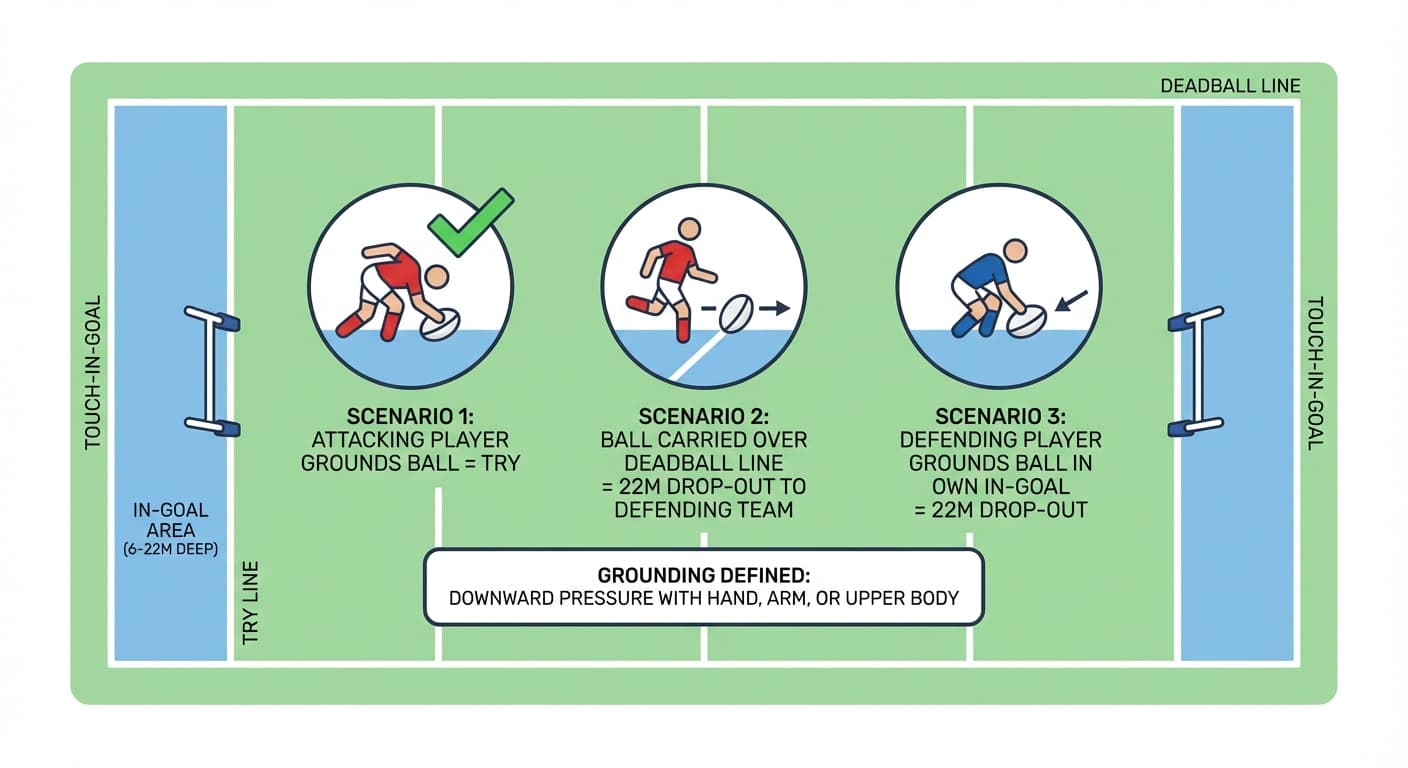
In-goal is the area between the goal-line and the dead-ball line at each end of the field. It is where tries are scored and where play can end with a dead ball.
---
GROUNDING THE BALL A try is scored when an attacking player grounds the ball in the opposition's in-goal. "Grounding" means:
- Touching the ball down with hand(s) or arm(s) while applying downward pressure, OR
- Falling on the ball so that it is under the player's body
You do NOT need to be moving forward — simply grounding the ball with downward pressure is enough.
A try is NOT scored if:
- The ball carrier is in touch-in-goal (on or beyond the touchline in the in-goal)
- The ball is held up (both in-goal and in-goal dead occurs)
- The ball reaches the dead-ball line before being grounded
---
TOUCH-IN-GOAL The touchline continues into the in-goal. If a player grounds the ball while touching the touchline in the in-goal (touch-in-goal), it is NOT a try — a 22-metre dropout is awarded.
---
DEFENDING IN IN-GOAL A defending player may ground the ball in their own in-goal:
- Forced into in-goal: If an attacking kick forces a defending player back into their in-goal, they may ground the ball — this results in a 22-metre dropout
- Penalty in in-goal: A scrum 5 metres from the goal line is awarded to the attacking team
Dead ball: The ball becomes dead when:
- It goes over the dead-ball line
- A player grounds the ball in their own in-goal
- It goes into touch-in-goal
22-metre dropout: Awarded to the defending team when the attacking team sends the ball dead in the in-goal or the defending team grounds it.
Sanction: Penalties in in-goal result in a scrum 5 metres from the goal line.
Real-World Examples
Scenario
A winger sprints to the corner and dives for the try-line. She reaches out with both hands and touches the ball down just inside the in-goal, near the corner post, but her feet are clearly in touch-in-goal.
Outcome
No try. The player was in touch-in-goal when she grounded the ball. The corner flag marks the touch-in-goal boundary. A 22-metre dropout is awarded to the defending team.
Scenario
A centre reaches the in-goal but a defender wraps both arms around him in a full bear-hug. Despite the tackle, the centre manages to press the ball down onto the turf.
Outcome
Try scored. Even though the player was held, he successfully grounded the ball with downward pressure. A try is awarded.
Scenario
The attacking team kicks the ball over the goal line. A defending fullback recovers it and runs it back, but doesn't ground it. She instead runs back into the field of play.
Outcome
Legal. The defending player did not ground the ball, so play continues. She runs back into the field of play and play continues normally.
Scenario
A kick from the opposing team goes over the dead-ball line without being touched.
Outcome
22-metre dropout for the defending team. The ball went dead over the dead-ball line. The defending team drop-kicks from anywhere on or behind their 22-metre line.
Scenario
A defending prop commits deliberate obstruction inside his own in-goal, preventing a certain try.
Outcome
The referee may award a penalty try under the posts. If the infringement prevented a certain try, Law 8 (Scoring) applies and a penalty try with conversion is awarded.