
Tackle: Ball Carrier Brought to Ground
Defines the tackle, and the duties of the tackler, tackled player, and other players arriving at the tackle. All must act quickly to keep the game moving.
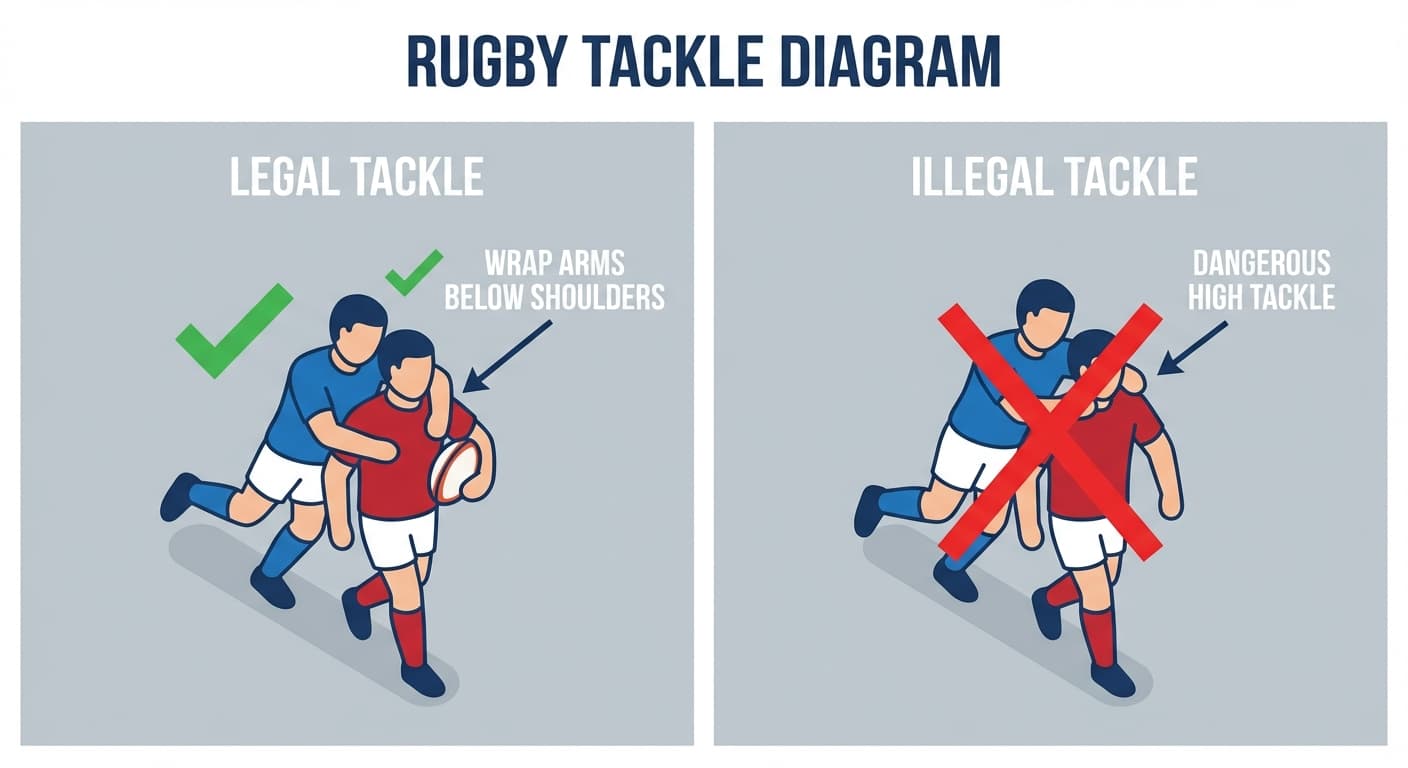
A tackle happens when a ball carrier is held by one or more opponents and brought to the ground. It is one of the most common — and most regulated — events in rugby.
What is "being brought to ground"? The ball carrier must have at least one knee touching the ground, or be sitting on the ground, or be on another player who is on the ground. Simply being grabbed is not a tackle unless the player goes to ground.
The tackled player must: 1. Immediately release the ball (place it on the ground or release it from their hands) 2. Immediately get up, or if they can't, roll away from the ball 3. Not play the ball again until they have returned to their feet
The tackler must: 1. Immediately release the tackled player 2. Get up or roll away from the ball and tackled player 3. Not interfere with the ball or play
Other players arriving at the tackle:
- Must arrive from their own side of the tackle (through the "gate")
- The gate is defined by the feet of the tackled player: players must come in along the line of that, not from the side
- Must be on their feet
- Can pick up the ball or contest for it once they've arrived legally
- Must not fall on the ball or tackled player
Ruck or play from tackle: A ruck may form around the tackle if players from both teams are in contact over the ball. Once a ruck forms, different rules apply (see Law 15).
Sanction: Penalty for any infringement.
Real-World Examples
Scenario
A ball carrier is tackled to the ground and immediately places the ball behind them (toward their own team). The tackler stays on top of the ball carrier for 3 seconds.
Outcome
Penalty against the tackler for not releasing immediately. The tackler must immediately release the tackled player and move away from the ball. The tackled player correctly placed the ball.
Scenario
A flanker arrives at a tackle from the side — not from behind the nearest teammate's feet — and picks up the ball.
Outcome
Penalty for coming through the gate illegally. The flanker must arrive from behind the ball (through the gate), not from the side. Arriving from the side gives an unfair advantage and disrupts the contest.
Scenario
A ball carrier is tackled. She keeps hold of the ball with both hands but manages to get back to her feet before any opponent challenges.
Outcome
Legal. A tackled player is not required to release the ball if they can get to their feet immediately. Once on their feet, they are no longer "tackled" and may continue playing.
Scenario
A number eight is tackled. Before the tackler releases him, a teammate from the same team arrives over the ball and a ruck forms with players from both sides.
Outcome
Once a ruck forms, Law 15 applies. The tackled player and tackler must still release immediately. The ball must be played with the feet in the ruck — players may no longer pick up the ball with their hands.
Scenario
A winger is tackled near the touchline. As she goes to ground, she deliberately places the ball in touch to slow down the opposition.
Outcome
Penalty against the winger. A tackled player must not deliberately place the ball in touch. The ball must be made available for continued play.