
Kick-off and Restart Kicks
Specifies how the game is started and restarted after scoring. Kick-offs are drop kicks from the centre; restart kicks follow scoring or the ball going dead.
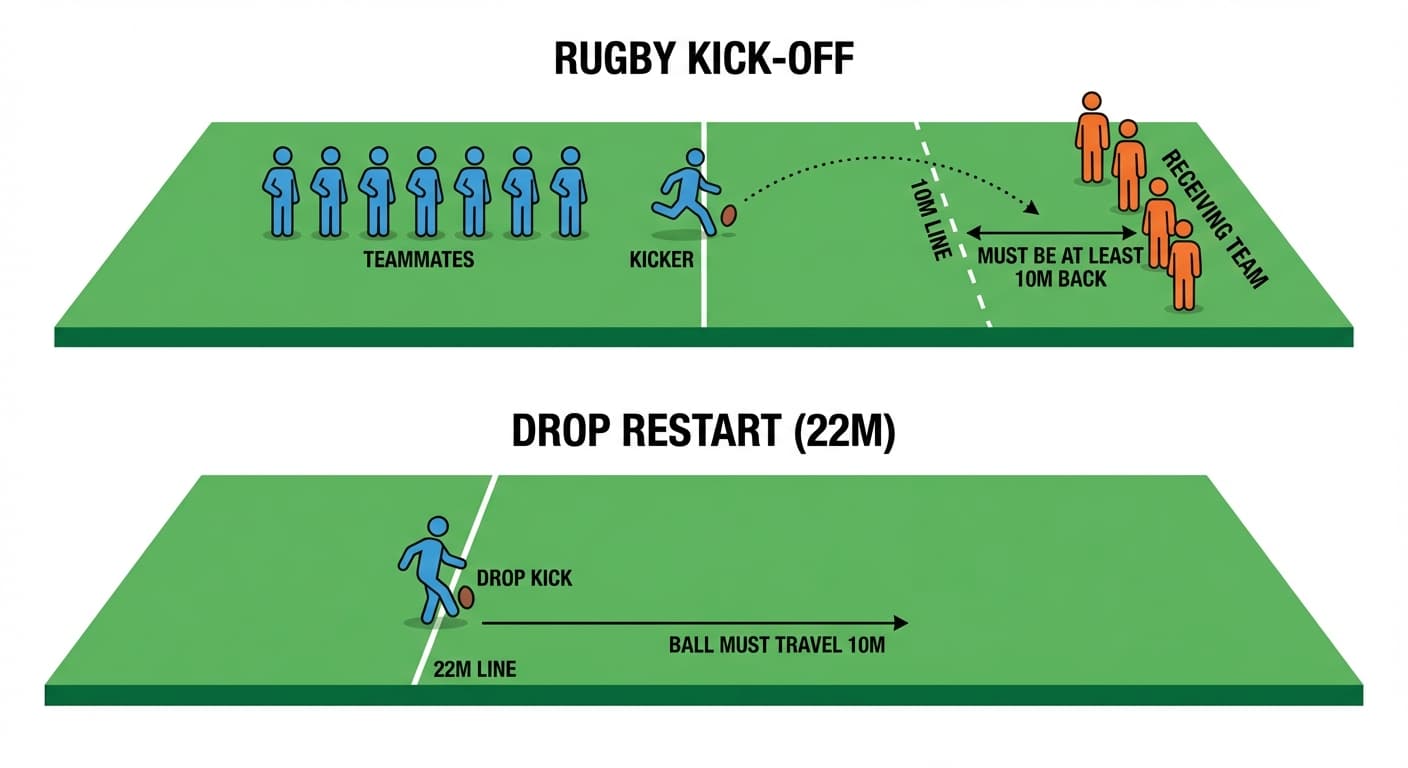
Kick-off: The game starts, and restarts after half-time and after a score, with a drop kick from the centre of the halfway line. The kick must travel at least 10 metres forward to reach the opponents' half, and the kicking team must be behind the ball.
Restart kicks: When the ball goes dead in in-goal (without a score), play restarts depending on who made it dead:
- Defending team made it dead: Attacking team gets a 5-metre scrum
- Attacking team made it dead (or the ball went dead over the dead-ball line off an attacking player): Defending team gets a drop-out from their 22-metre line (a 22-drop)
Key rules for kick-offs:
- The kick must reach the opponents' 10-metre line (not just cross the line — it must be received beyond it, unless an opponent plays it first)
- All kicking team players must be behind the ball at kick-off
- Opponents must be on or behind their 10-metre line
- If the ball doesn't reach the 10-metre line, the opponents can: accept the kick, have a scrum at the centre, or have the kick retaken
- If the ball goes directly into touch, opponents can: accept, scrum at centre, or retake
Drop-out (22-drop): A drop kick from anywhere on or behind the kicker's 22-metre line. The ball must cross the 22-metre line. Opponents must be outside the kicker's 22 when the kick is taken.
Real-World Examples
Scenario
The kick-off is taken and the ball only travels 8 metres, falling short of the opponents' 10-metre line.
Outcome
The receiving team has three options: accept the kick as played (and play from where it landed), opt for a scrum at the centre of the halfway line with the put-in, or ask for the kick to be retaken. This is a common choice at elite level where a scrum at the centre is often chosen.
Scenario
An attacking winger chases a grubber kick into the opponents' in-goal. Unable to ground the ball, she knocks it over the dead-ball line.
Outcome
The defending team is awarded a 22-drop (drop-out). The attacking winger was the last to touch the ball before it crossed the dead-ball line, so the defending team restarts from behind their own 22.
Scenario
A fullback takes a drop-out but the kick only travels 18 metres, not reaching the 22-metre line.
Outcome
The kicking team has failed to cross the 22. The opposing team may accept the kick, opt for a scrum where the ball was kicked, or ask for the drop-out to be retaken.
Scenario
At kick-off, two players from the kicking team are clearly in front of the kicker when the ball is struck.
Outcome
Infringement at kick-off. The kicking team had players in front of the ball when it was kicked. The receiving team may have a scrum at the centre or ask for the kick to be retaken.