
Advantage
Allows play to continue after an infringement if the non-offending team benefits.
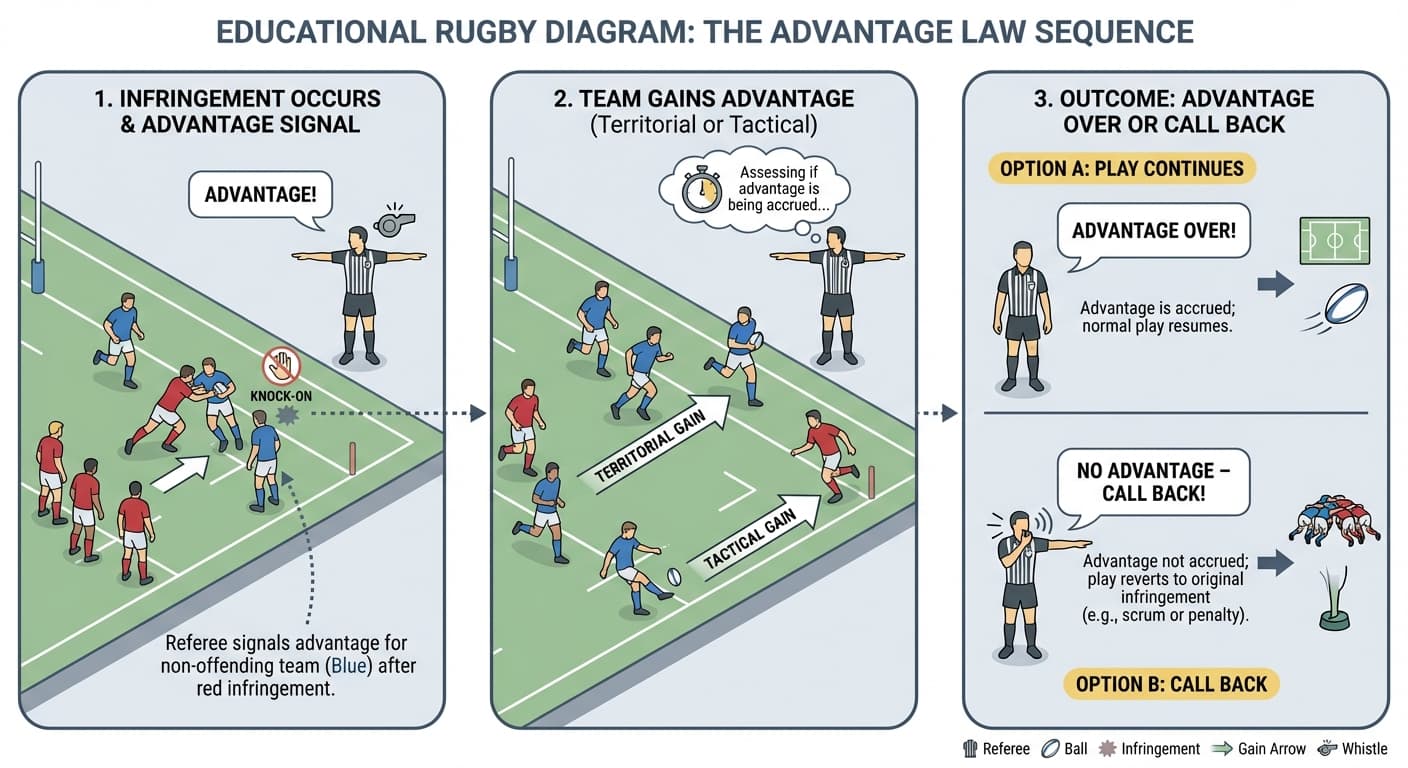
Advantage is one of rugby's most important concepts for keeping the game flowing. When a team commits an infringement (like offside or a knock-on), the referee doesn't always stop play immediately. Instead, they shout "Advantage!" and allow the non-offending team to keep playing if they stand to gain something from it.
There are two kinds of advantage: tactical (the attacking team has a good attacking opportunity) and territorial (play has moved into the opposing team's half). The advantage must be "clear and real" — just having the ball isn't enough.
If the non-offending team scores, gets a good attacking opportunity, or the advantage fizzles out, the referee brings play back to the original infringement. This law exists to prevent teams from deliberately committing minor infringements to stop promising attacks.
There are specific situations where advantage cannot apply and the referee must blow the whistle immediately — for example, when the ball comes out of either end of a scrum tunnel, when a scrum is wheeled more than 90 degrees, or when a player is seriously injured.
Real-World Examples
Scenario
The defending team knock on in their own 22. The attacking team picks up the ball and score a try two phases later.
Outcome
The referee played advantage after the knock-on. The attacking team gained a clear and real advantage — they scored a try. Advantage is over; the try stands. There is no need to go back to the knock-on.
Scenario
A team is offside and the referee shouts "Advantage!" The attacking team kicks forward but their kick goes straight into touch.
Outcome
The attacking team failed to gain a clear and real advantage. The referee brings play back to the original offside, awards a penalty to the non-offending team, and they restart with that penalty.
Scenario
The scrum is wheeled past 90 degrees. The attacking team picks up the ball and breaks for the try line.
Outcome
Advantage cannot be played in this situation (Law 7.3c). The referee must blow the whistle immediately when the scrum is wheeled past 90 degrees, regardless of what happens next.
Scenario
A team commits a penalty. While advantage is being played, the same team commits a second penalty.
Outcome
Under Law 7.2(d), the referee stops play and allows the captain of the non-offending team to choose the most advantageous sanction from the two penalties committed.